
Clean your colon with enemas using enema kits.
 Colon cleansing via enemas have been recorded in history since 600 BC as noted in Babylonian inscriptions. They used very basic enema equipment, just like we do today. Enemas were a normal part of medical treatment up to the 1950s. So it’s not new!
By removing unwanted material from the colon wall, the peristaltic action is allowed to function properly and if the colon has been distorted by segmentation or strictures, it allows the colon to come back into shape of its own accord. Enemas also stimulate reflex points in the colon that connect with other organs in the body.
With our easy to use Enema kits, enemas are relaxing, worthwhile and you feel  reallygoodafterwards, having removed a great deal of old faecal matter. Read much more about enemas at our site Enemainfo.com or buy enema kits here.
Introduction to Enemas
Water enemas can be conducted by one’s self in a bathroom, near a toilet bowl.
Filtered, warm water enemas are most common; however other ingredients can be added for benefit.
Enemas can be helpful if you are experiencing severe constipation.
Enemas should be kept to a minimum and used only for short periods.
Buy different Types of Enemas
There are three basic types of enemas
- Open
- Closed
- Pump
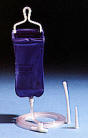 The open type is a gravity fed system and comes under many names, bag enema, enema can, enema douche and fountain enema are the most popular and most enema equipment sold to the general public is of the open form. This is because it is easy to use this enema kit, by your self. The enema bag mounts easily in your bathtub and it is easier to install the enema tip or enema nozzle while lying down. It is great for the traveller and it is cleaned easily and packs up neatly. The 2 litre enema bag is most common and comes with the necessary hoses and tap. Easy to handle and great for travelling or home use. Easy to clean. Contains everything you need to do an enema. There is a long transparent tube (1.4m - about 55 inches) which gravity feeds the fluid from the bag down via a small tap mechanism to the tip. Extra hose attachment can be purchased Rectal Tube. The end of the enema tip is about the width of an average ballpoint pen casing and only 7cm (2 3/4 inches) long. The vaginal douche is the longer of the two tips and has a slight kink in it. This is for vaginal use only and should not be inserted in the anus. Will last for years with proper care. Suited for anal hygiene and personal care. On / Off valve (not clamp). It is a product that has been used safely by thousands of people. Safer than many designs as the position of the tap prevents the anal tip (the smaller of the two tips supplied) from being inserted too far into the anus, although all enema kits should be used with caution. Very straight forward to assemble although it comes with detailed instructions. Designed to enable you to visibly check all parts easily prior to use. Collapsible so that you can flat pack it to store away or take with you easily when traveling.
Further directions for use can be obtained here. Buy Enema Bag 
The closed system is commonly referred to as the bottle system or large enema. 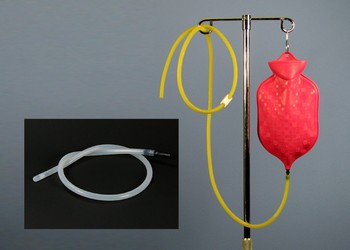 Traditionally hot water bottles were converted for use as a douche and the closed system enema kit comes with a hot water bottle, enema nozzle, clamp, enema hose and carrying case.
Using the closed system is similar to the open system, gravity is employed in a slightly different way and the pressure of the system can now be increased or reduced buy external pressure on the bag. Some experienced colon cleansers find this to be an advantage. Any closed system is more difficult to keep clean. Further directions for use can be obtained here
Buy a water bottle closed system enema kit
The Pump System is a closed system, it is often called the enema pump system or enema bulb system. There are two main types of pump systems.
- The Higginson Enema aka, Higginson Syringe or Higginson Syringe Enema
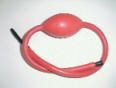
- Bulb Enema or Enema Bulb
These types of enema kits allow the user to control pressure through the pumping of a bulb or chamber that can be squeezed to force the flow of the liquid being used.
The Higginson Syringe is often used where the body is submerged in water, for example in the ocean or a river. Only experienced colon cleansers use this system as getting air into the system is possible and probable without extreme care. Further directions for use can be obtained here
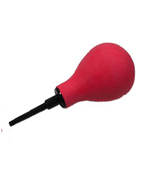 The bulb system is a small delivery system, good for use with implants or with children where smaller amounts are safer. The device is a bulb with a built in removable enema nozzle / enema tip. Sometimes referred to as an adult enema syringe, bulb enema syringe or just bulb syringe. This form of enema equipment is not an enema kit like the others but instead one device with a limited delivery. Easy to use and control the amount of water flow. Easily washable in warm water. Safe to use with all lubricants. Great for travelling. 224 ml liquid capacity. Small, portable and durable. No assembly required. Dmensions 15x8x8cm. Comes with detailed instructions.
Further directions for use can be obtained here
Finally there is the implant. Traditionally implants were 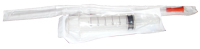 given with a large enema kit. Now implants are almost exclusively given with a rectal tube and a 60ml syringe. This is because you can judge accurately the amount used when implanting. The accuracy of dosage is especially important with Ayurvedic Oil Enemas. The implant method is essential to the process of re-establishing intestinal flora after enemas. Injecting pro-biotics anally is as important as taking them orally. This is especially true when assisting people who have been fasting or cleansing for extended periods.
In more recent times, a very popular form of open enema involves the use of coffee. The coffee enema is used because it helps the liver to eliminate toxins but leaves you with reduced flora in the intestines. Therefore implants of pro-biotics necessary to re establish a healthy bowel must be administered and again, the best system for implantation is the rectal tube and a 60ml syringe. Further directions for use can be obtained here